

Project Overview
Data labeling is the bottleneck of modern AI. We built an autonomous multi-agent system where agents collaborate to label images, text, and audio. The system features a 'Supervisor Agent' that critiques labels and a 'Worker Agent' that performs the task, creating a self-improving loop.
System Architecture
The system uses a Hub-and-Spoke agent architecture. A central 'Orchestrator' manages task distribution. 'Specialist' agents handles specific data types (Vision, NLP). All agents share a Vector Memory Store for context retention.
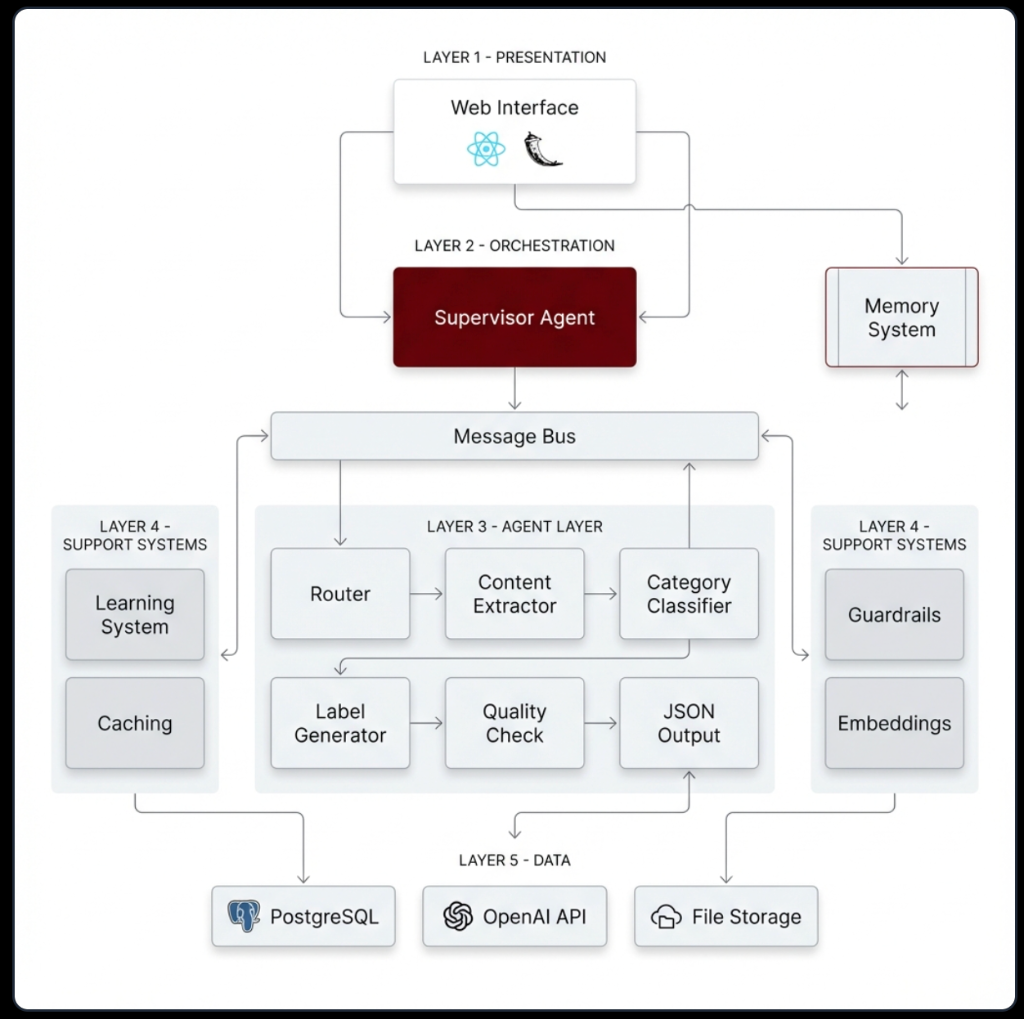
Orchestrator
LangGraph state machine for workflow control
Vision Agent
GPT-4o for complex image reasoning
Memory Store
Qdrant Vector DB for semantic retrieval
Verification
Cross-validation consensus protocol
Implementation Details
Code Example
from langgraph import StateGraph

class LabelingState(TypedDict):
    image_url: str
    current_label: str
    confidence: float

def supervisor_node(state: LabelingState):
    # Supervisor critiques the label
    if state['confidence'] < 0.9:
        return 'send_to_human_review'
    return 'finalize_label'

workflow = StateGraph(LabelingState)
workflow.add_node('supervisor', supervisor_node)
# ...
Agent Memory
Using a shared vector memory allows agents to recall similar past edge-cases, preventing them from making the same mistake twice.
Workflow
Ingestion: Raw data hits the pipeline.
Routing: Orchestrator identifies data type.
Labeling: Worker agents generate initial labels.
Critique: Supervisor agent reviews confidence.
Output: JSON structure pushed to data lake.

Results & Impact
"This platform allowed us to label our entire training dataset in weekend, a task that was projected to take 3 months."
Speed
Reduced TTM (Time to Market) by 4 months
Quality
Surpassed human-crowdsourced accuracy
Scale
Auto-scaled to 100 concurrent agents
About the Author
Contributors


Ready to Build Your AI Solution?
Get a free consultation and see how we can help transform your business.