Industrial-Strength Data Validation with Pydantic
How to use Pydantic to enforce strict data schemas in Python applications, ensuring that 'garbage in' never leads to 'garbage out'.


Project Overview
In dynamic languages like Python, data bugs are common. Pydantic solves this by parsing and validating data against pre-defined classes. We use it everywhere in our stack—from validating API requests in FastAPI to cleaning LLM outputs. This case study demonstrates advanced usage patterns like custom validators, nested models, and settings management.
System Architecture
Pydantic sits at the boundary of your application. Whether it's an incoming HTTP request, a database query result, or a configuration file, Pydantic intercepts the raw data, validates it against a schema, and converts it into a typed Python object. If validation fails, it raises a precise error detailing exactly what went wrong.
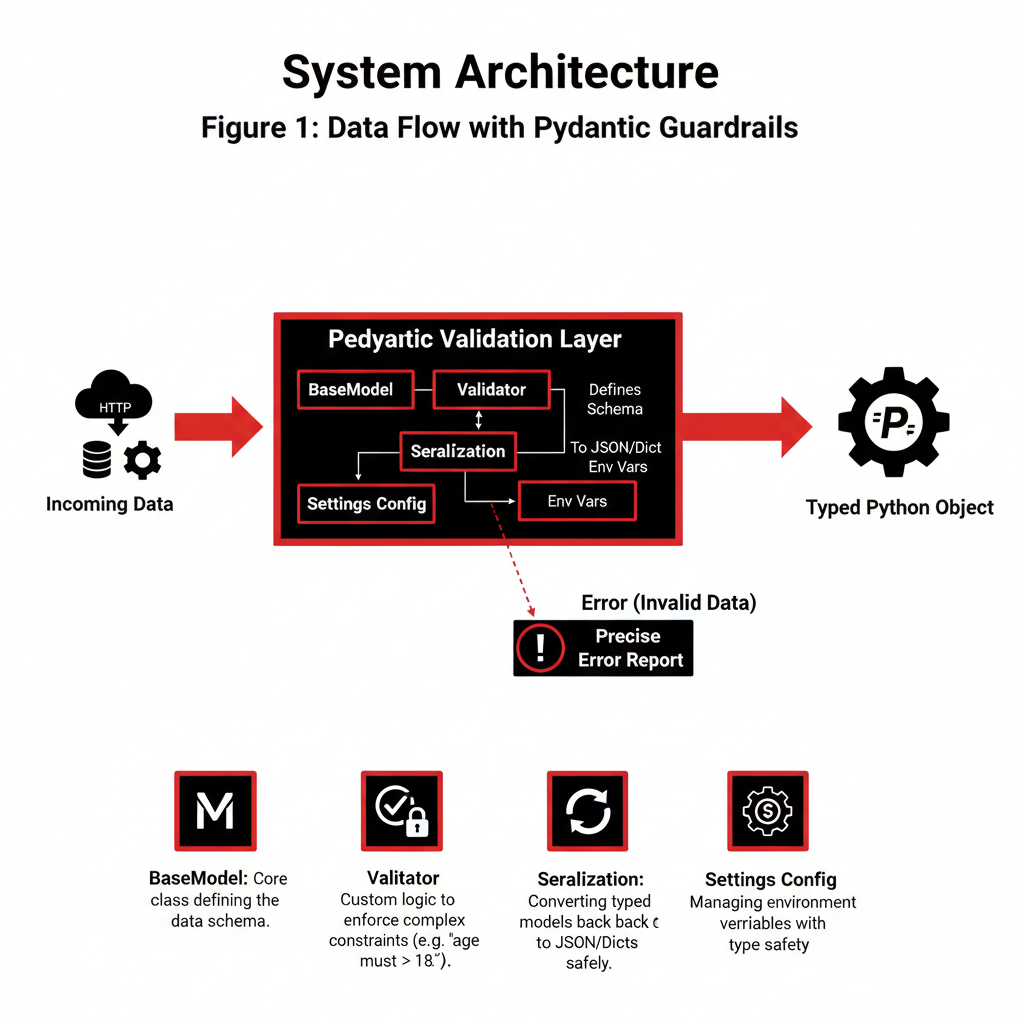
BaseModel
The core class defining the data schema.
Validator
Custom logic to enforce complex constraints (e.g., 'age must be > 18').
Serialization
Converting typed models back to JSON/Dicts safely.
Settings Config
Managing environment variables with type safety.
Implementation Details
Code Example
from pydantic import BaseModel, EmailStr, field_validator\n\nclass UserSignup(BaseModel):\n username: str\n email: EmailStr\n age: int\n\n @field_validator('age')\n def check_age(cls, v):\n if v < 18:\n raise ValueError('Must be 18+')\n return v\n\n# Usage\ntry:\n user = UserSignup(username='apex', email='bad-email', age=10)\nexcept ValueError as e:\n print(e.json()) # Detailed error reportAgent Memory
Use `Field(alias='camelCaseName')` to seamlessly map incoming JSON with Javascript-style naming conventions to Pythonic snake_case attributes.
Workflow
Data Ingress: API receives JSON payload.\n2. Parsing: Pydantic attempts to verify types (int, str, bool).\n3. Validation: Custom validators run for business logic checks.\n4. Instantiation: A valid Python object is created.\n5. Usage: Application code runs with full IDE autocompletion support.

Results & Impact
"Pydantic is the single most important library in our Python stack. It catches 90% of bugs before code even runs."
Security
Prevents malformed data injections.
Clarity
Code is self-documenting via type hints.
Speed
Pydantic V2 (Rust) provides massive serialization speedups.
About the Author
Ready to Build Your AI Solution?
Get a free consultation and see how we can help transform your business.