Champions Gen: Sports Intelligence Platform
AI-powered player intelligence predicting injuries, forecasting performance, and estimating market value for professional sports teams.

Project Overview
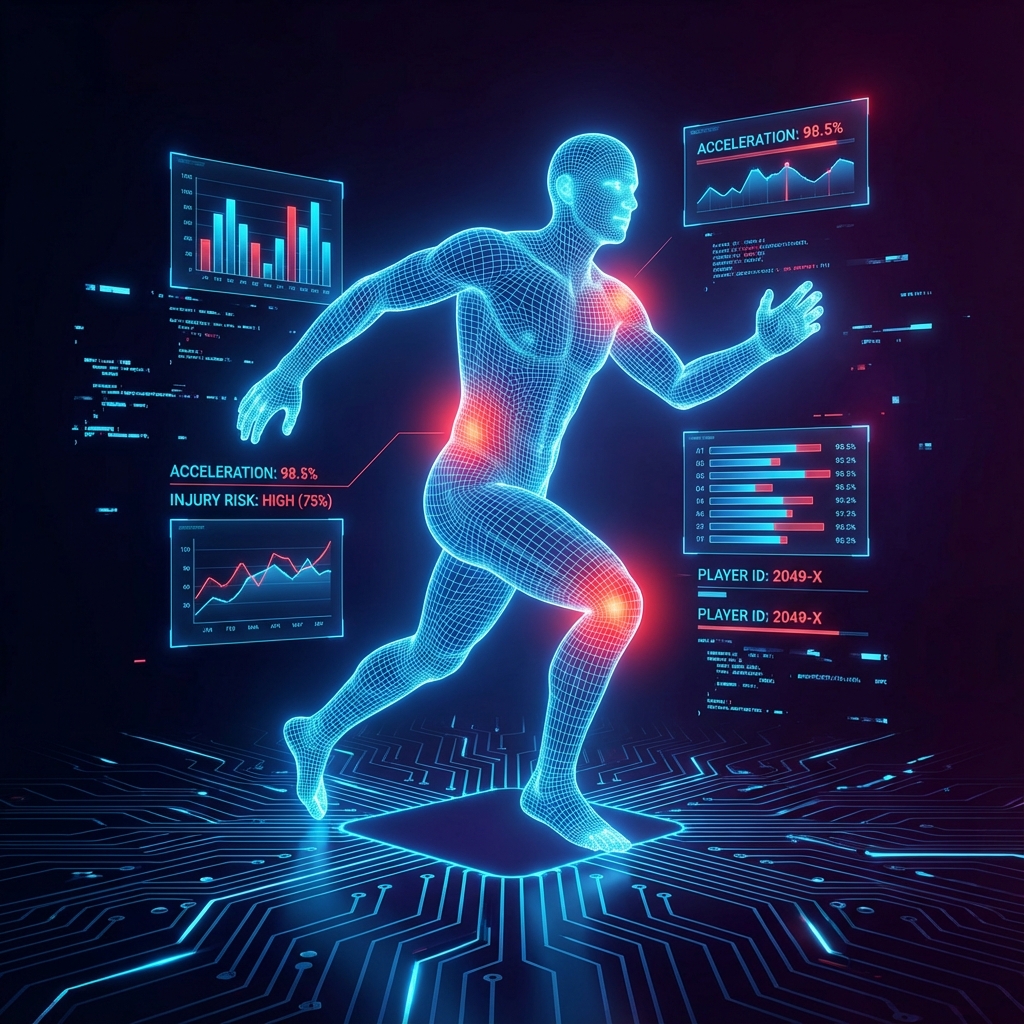
Champions Gen is a cutting-edge player intelligence platform designed to give professional clubs a competitive edge. By aggregating data from GPS wearables, medical records, and match statistics, it predicts injury risks before they happen and forecasts future player performance. It serves as a central nervous system for decision-making, from the physio room to the transfer market.
System Architecture
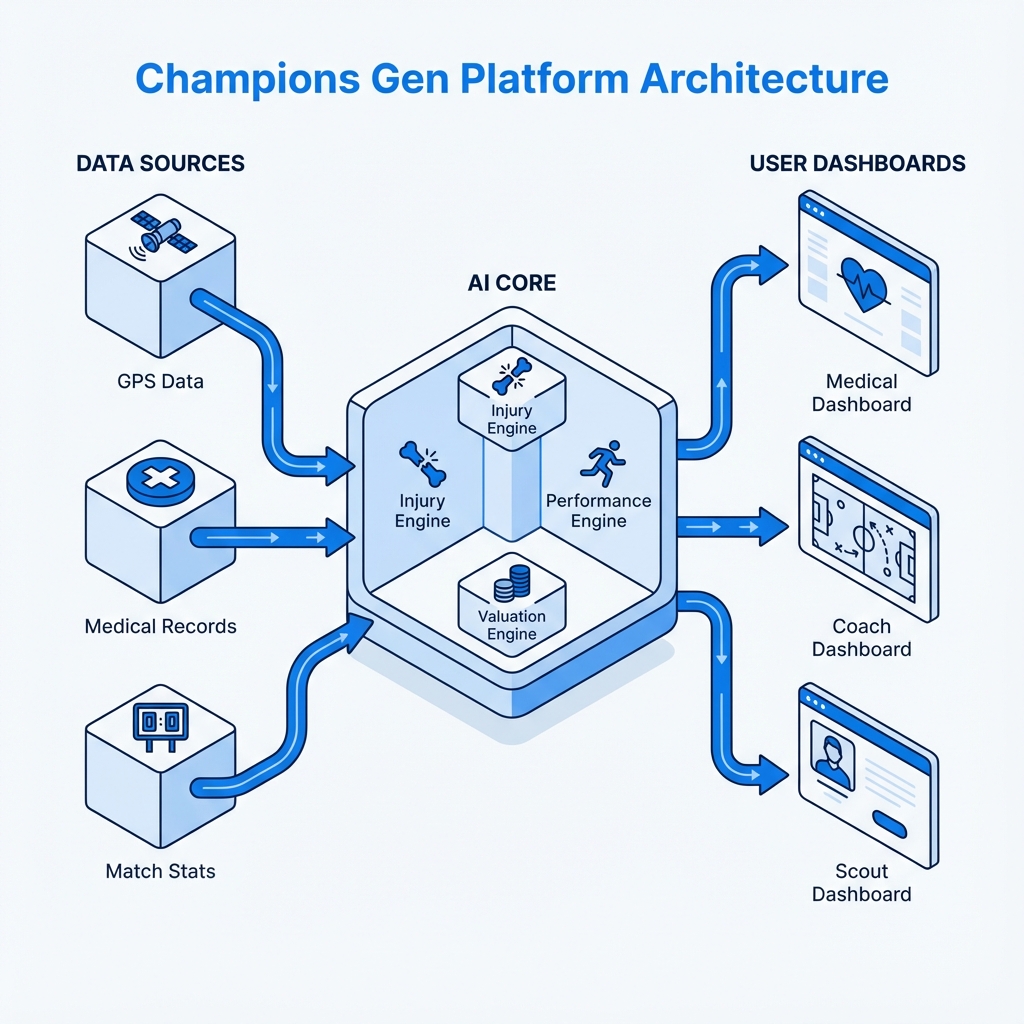
The platform is built on a modular 'AI Core' containing three distinct engines: Injury Prediction, Performance Forecasting, and Market Valuation. Data flows from external sources (GPS APIs, Medical EMRs) through a normalization layer before being processed by these engines. The insights are then served to role-specific dashboards for Medical Staff, Coaches, and Scouts.
Injury Engine
Multi-factor temporal modeling (Survival Analysis) for risk scoring.
Performance Engine
Sequence models forecasting player ratings and consistency.
Valuation Engine
Market regression models estimating fair transfer values.
Explainability Layer
SHAP-based feature importance to explain 'Why high risk?'.
Implementation Details
Code Example
class InjuryPredictionEngine:
    def predict_risk(self, player_id: str, load_metrics: Dict):
        """
        Predicts injury probability using ensemble voting.
        """
        # 1. Feature Engineering (Rolling averages, ACWR)
        features = self.preprocessor.compute_workload_ratios(load_metrics)

        # 2. Multi-Model Inference
        temporal_risk = self.lstm_model.predict(features['sequence'])
        biomech_risk = self.xgb_model.predict(features['tabular'])

        # 3. Consensus Scoring
        combined_score = (0.6 * temporal_risk) + (0.4 * biomech_risk)

        # 4. Action Mapping
        action = "MONITOR"
        if combined_score > 0.8:
            action = "REST_IMMEDIATE"
        elif combined_score > 0.6:
            action = "REDUCE_LOAD_50_PERCENT"

        return RiskOutput(
            score=combined_score,
            category=self.get_category(combined_score),
            recommended_action=action
        )
Agent Memory
Raw physical data isn't enough. Our models heavily weight 'Contextual Data' like fixture congestion, travel distance, and weather conditions, which often act as the tipping point for fatigue-related injuries.
Workflow
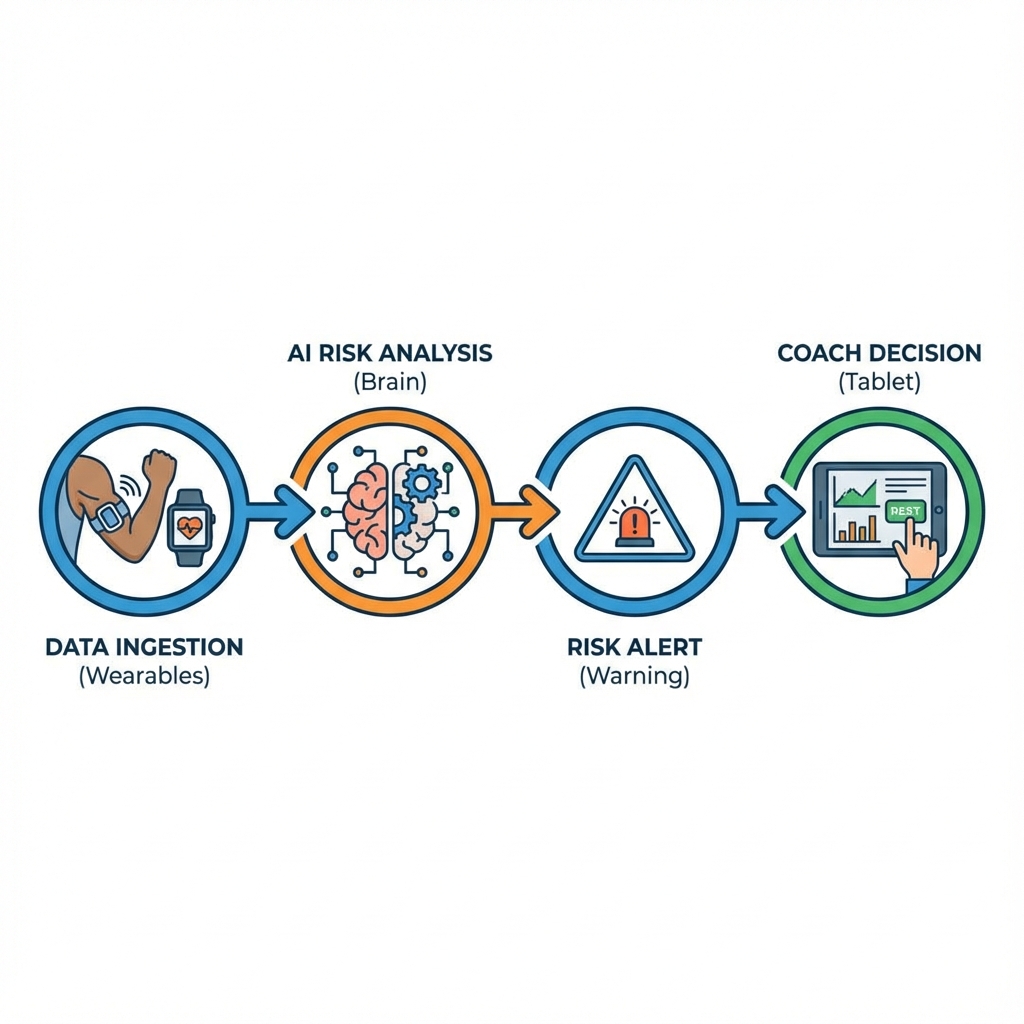
Data collection happens automatically via API integrations with wearable providers. The AI analyzes this stream in real-time. If a risk threshold is breached, an alert is pushed to the Medical Team's mobile app. Coaches review readiness reports before training, and Scouts use valuation projections during transfer windows.
Results & Impact
"Champions Gen acted like a smoke alarm for our squad. We identified three potential hamstring tears in preseason and adjusted loads, keeping our key players available for the finals."
Availability
Key player availability increased by 15% season-over-season.
ROI
Saved an estimated $4M in lost wages and medical costs.
Scouting
Identified undervalued talent with 20% projected growth upside.
About the Author
Parmeet Singh Talwar
AI Context Engineer
Apex Neural
Parmeet engineers context-driven AI that combines LLMs with structured backend architecture and multi-platform integrations. He builds AI-powered systems with secure OAuth, fine-tunes open-source LLMs, and integrates image and video generation into production pipelines. Focused on clean design and system reliability.
Contributors

Ready to Build Your AI Solution?
Get a free consultation and see how we can help transform your business.