Scalable Node.js Backend for High-Traffic Application
How we architected and built a scalable Node.js backend serving 2M+ daily API requests with 99.99% uptime, featuring horizontal scaling, intelligent caching, background job processing, and comprehensive monitoring for an enterprise SaaS platform.

Project Overview
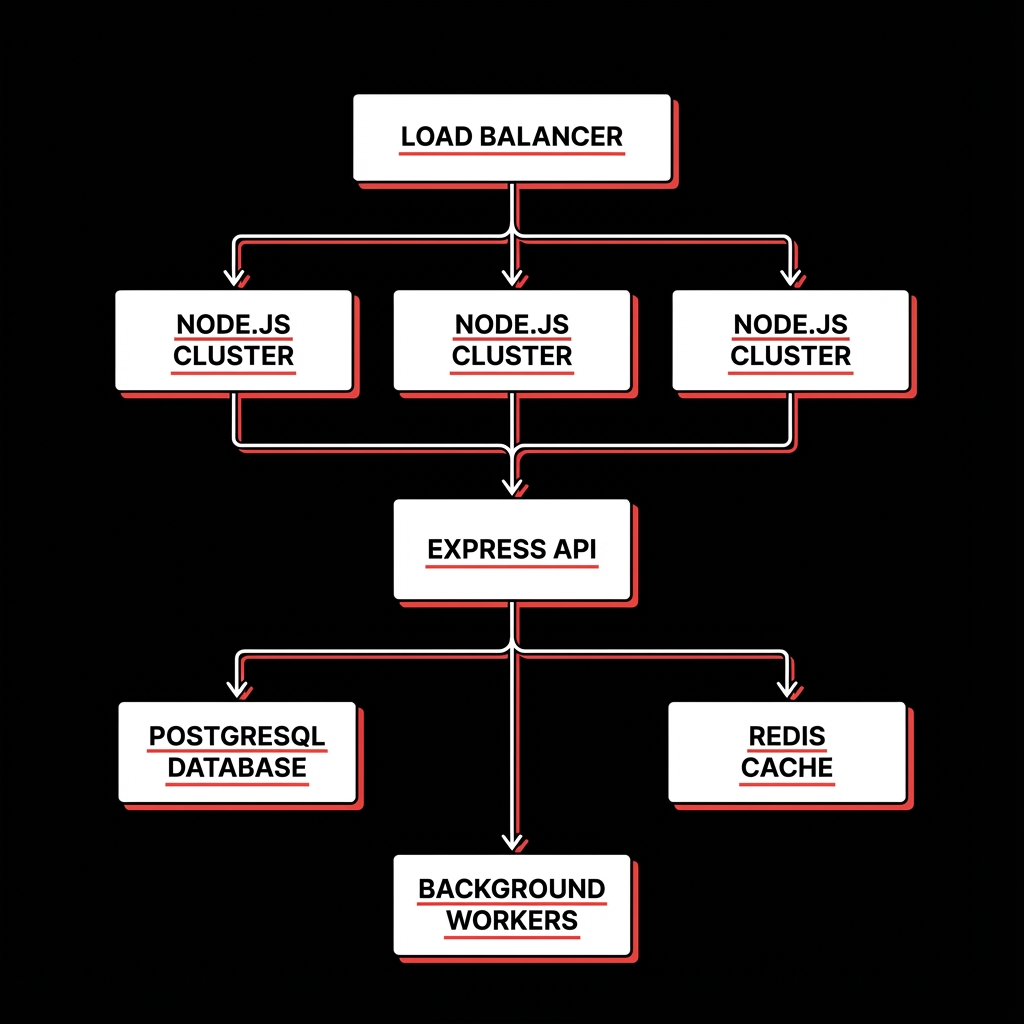
Our enterprise SaaS platform required a robust backend capable of handling millions of API requests daily while maintaining sub-100ms response times. The previous PHP-based system couldn't handle traffic spikes and frequently experienced timeouts during peak hours. We rebuilt the backend using Node.js with Express, implementing a layered architecture with clear separation between controllers, services, and data access layers. The solution features connection pooling for PostgreSQL, Redis for caching and session management, Bull queues for background job processing, and PM2 cluster mode for utilizing all CPU cores. Docker containerization enables horizontal scaling across multiple instances behind a load balancer.
System Architecture
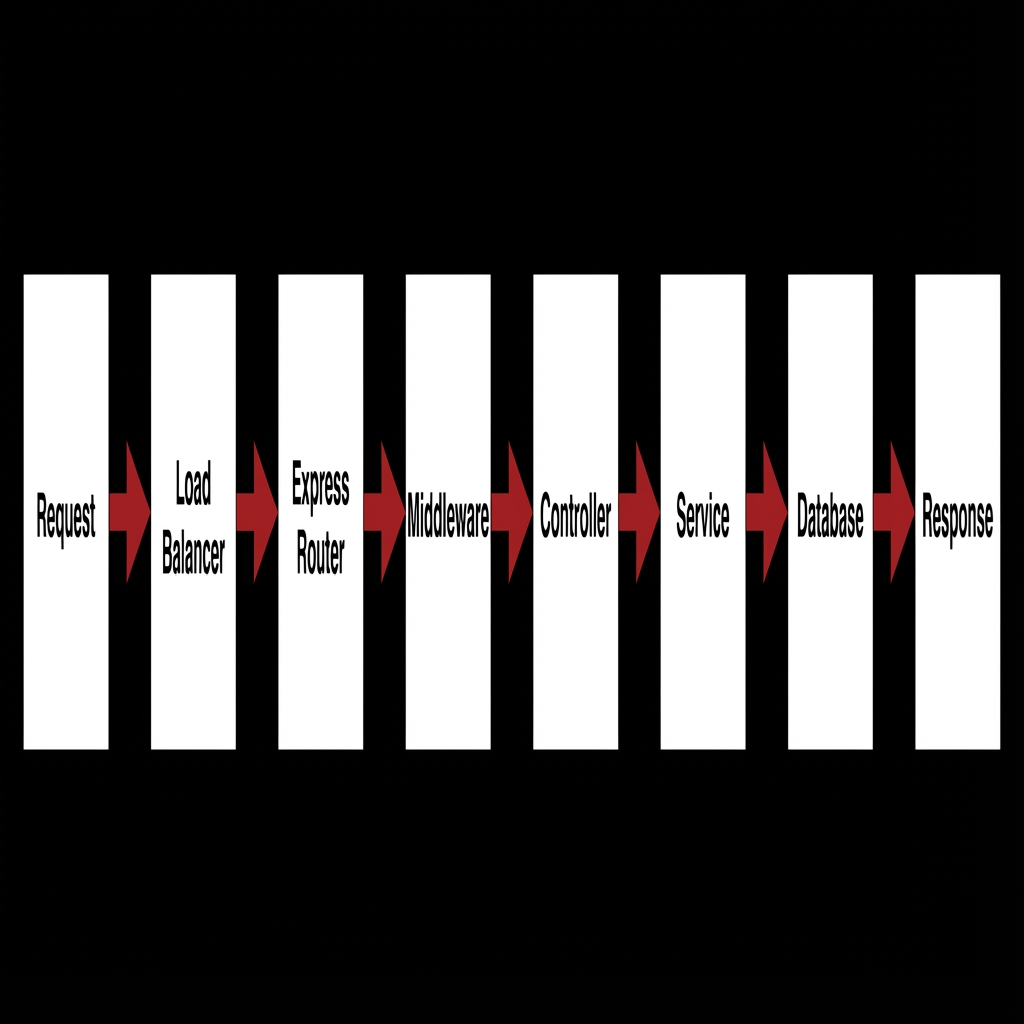
The backend follows a layered architecture with Express handling HTTP requests, routing them through middleware for authentication and validation, to controllers that orchestrate business logic in service classes, which interact with the data layer through repositories. PostgreSQL serves as the primary database with connection pooling via pg-pool. Redis provides caching for frequently accessed data and session storage. Bull queues handle background jobs like email sending, report generation, and data processing. PM2 manages the Node.js cluster with automatic restarts and load balancing across CPU cores. The entire stack is containerized with Docker and orchestrated with Docker Compose for local development and Kubernetes for production.
Express.js
Fast, unopinionated web framework with middleware pipeline for authentication, validation, and error handling
PostgreSQL
Primary database with connection pooling, prepared statements, and transaction support for data integrity
Redis
In-memory caching with 85% hit rate, session storage, and pub/sub for real-time features
Bull Queues
Background job processing for async operations with retry logic, job scheduling, and monitoring dashboard
PM2 Cluster
Process manager with cluster mode utilizing all CPU cores, automatic restarts, and zero-downtime reloads
Docker + Kubernetes
Containerization for consistent environments and orchestration for horizontal scaling and self-healing
Implementation Details
Code Example
// Express Application with Layered Architecture
import express from 'express';
import { authMiddleware } from '@/middleware/auth';
import { rateLimiter } from '@/middleware/rateLimit';
import { errorHandler } from '@/middleware/errorHandler';
import { userRoutes } from '@/routes/users';
import { redisClient } from '@/config/redis';

const app = express();

// Middleware pipeline
app.use(express.json({ limit: '10mb' }));
app.use(rateLimiter({ windowMs: 60000, max: 100 }));
app.use(authMiddleware);

// Cache middleware for GET requests
app.use(async (req, res, next) => {
  if (req.method === 'GET') {
    const cached = await redisClient.get(req.url);
    if (cached) return res.json(JSON.parse(cached));
  }
  next();
});

// Routes
app.use('/api/users', userRoutes);
app.use('/api/products', productRoutes);

// Error handling
app.use(errorHandler);

// Start with PM2 cluster mode
export default app;
Agent Memory
Configuring PostgreSQL connection pooling (min: 5, max: 50) eliminated connection exhaustion during traffic spikes. Without pooling, the server crashed at 500 concurrent requests; with pooling, it handles 10,000+.
Workflow
Request Received: Client request hits load balancer and routes to available Node.js instance.
Middleware Pipeline: Request passes through rate limiting, authentication, and validation.
Controller Layer: Route handler validates input and calls appropriate service.
Service Layer: Business logic executes, coordinating between multiple data sources.
Cache Check: Redis cache checked before database query; cache miss triggers DB query.
Database Query: PostgreSQL query executed with prepared statements and connection pooling.
Response Caching: Successful responses cached in Redis with appropriate TTL.
Background Jobs: Async operations queued to Bull for processing without blocking response.
Results & Impact
"The Node.js rebuild was transformational. Our old system would crash during sales events; now we handle 10x the traffic without breaking a sweat. The 50ms response times have noticeably improved user experience."
Response Time
Average response time reduced from 800ms to 50ms (94% improvement)
Throughput
From 500 to 10,000+ concurrent connections without degradation
Availability
99.99% uptime achieved through clustering and auto-restart
Cost Efficiency
40% reduction in server costs through efficient resource utilization
About the Author
Sunnykumar Lalwani
Principal Engineer - Backend and Systems Architecture
Apex Neural
12+ years designing high-performance backend and distributed systems. Expertise in scalable system design, DevOps automation, and cloud-native infrastructure. Strong focus on AI-powered applications, LLM integrations, and data-driven workflows. Combines hands-on full-stack work with architectural governance.
Ready to Build Your AI Solution?
Get a free consultation and see how we can help transform your business.